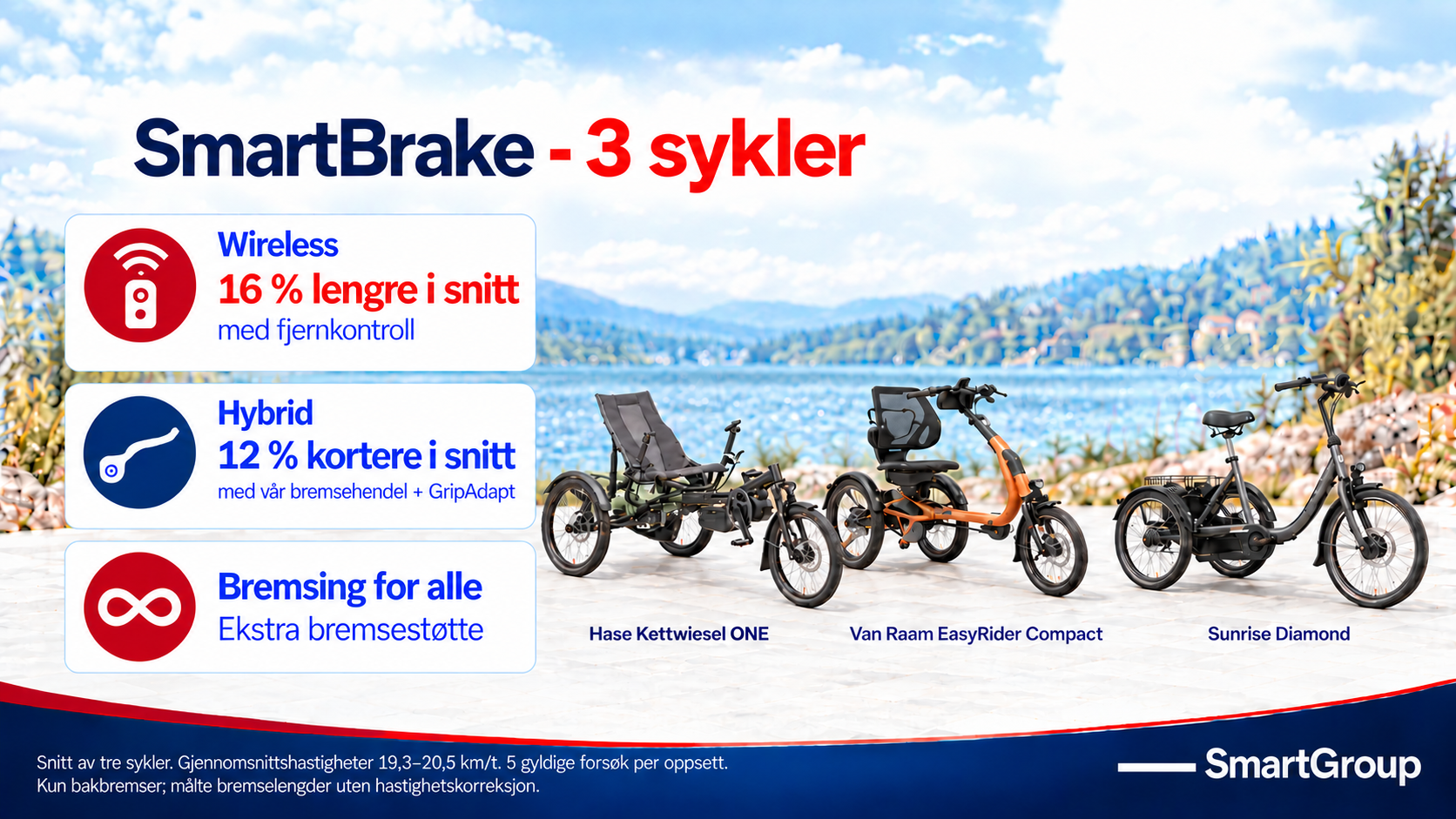
During the summer we have conducted a series of braking tests with SmartBrake Hybrid on an adapted three-wheeled bike for adults. The goal was to see how SmartBrake works in practice and to compare the solution with the bike’s original braking system.
Strong braking that is easier to activate
SmartBrake The brake is designed for people who may have difficulties braking quickly and powerfully with a traditional brake handle. If the cyclist is unable to squeeze the brake with sufficient force or speed, the full capacity of the original brake will also not be utilized.
This is where SmartBrake has one of its most important advantages. With a simple press of a button, the system can activate the necessary braking force. For a cyclist who has challenges with hand strength, grip, or mobility, this will practically mean shorter stopping distance than with a traditional brake that cannot be fully activated.
The testing also showed that SmartBrake delivers strong braking power and closely matches the bike's original braking system in total stopping distance measured.
With the original dual rear brakes, the average stopping distance was measured at 4.6 meters, activated by an adult hand in good condition. For a person with reduced functional ability, the stopping distance will quickly double or more.
With SmartBrake, the stopping distance was measured to be 5.1 meters. An important part of the difference lies in how SmartBrake is activated. When the wireless button is pressed, the signal must first be transmitted to the system. A certain signal delay is an inherent part of wireless communication. Then the hydraulic pressure is built up. The total activation phase in the test was approximately 0.3 seconds. It is barely noticeable at low speeds, but at 20 km/h it corresponds to about 1.6 meters, and this distance is included in the measured stopping distance.
Leaving aside this recorded activation phase, the calculated braking distance with SmartBrake would be shorter than with the original brake. This illustrates that the actual braking force is very good when the system is activated.
For the target group, however, it is even more important that SmartBrake makes this braking power available so that the result does not depend on how hard or fast the cyclist manages to squeeze on a brake lever.
The hybrid lever provides even more possibilities
The SmartBrake Hybrid lever provides an additional way to use the same braking system. It can be combined with GripAdapt, which reduces the distance the hand must grip over and provides better opportunities for ergonomic adaptation.
The hybrid lever is hydraulically connected directly to the brakes and operates independently of whether the SmartBrake system is on or has power. Therefore, the regular hydraulic braking is not affected by the SmartBrake system.
This was also confirmed in the test. The hybrid solution on the dual rear brakes had an average stopping distance of 4.6 meters, practically identical to the original braking system. The SmartBrake integration thus did not affect the performance of the direct hydraulic brake.
The hybrid lever is well suited for people who can use a brake lever and want the fastest possible immediate braking, but who at the same time need assistance in other ways. This may include the need for a companion to be able to brake, or the need for the cyclist to be supported due to motor or cognitive challenges. The cyclist can then use the hydraulic lever as normal, while SmartBrake provides an additional opportunity for assistance when needed.
Several ways to slow down safely
The most important result from this summer's testing therefore concerns more than the number of meters from activation to stop. The tests show that SmartBrake Hybrid maintains the bike's original braking performance, while providing new and more flexible ways to activate the brakes.
For people with needs for assistance, this can change the entire experience of safety on a bike. SmartBrake can make effective braking easier for people who have challenges with a traditional brake handle. The hybrid handle also provides direct hydraulic braking for those who can use this solution, with the option of ergonomic adjustment through GripAdapt and assistance from an accompanying person when needed.
For us, this is the core of SmartBrake: making cycling possible for more people.