
Article
Brakes for adapted cycles – testing SmartBrake Hybrid
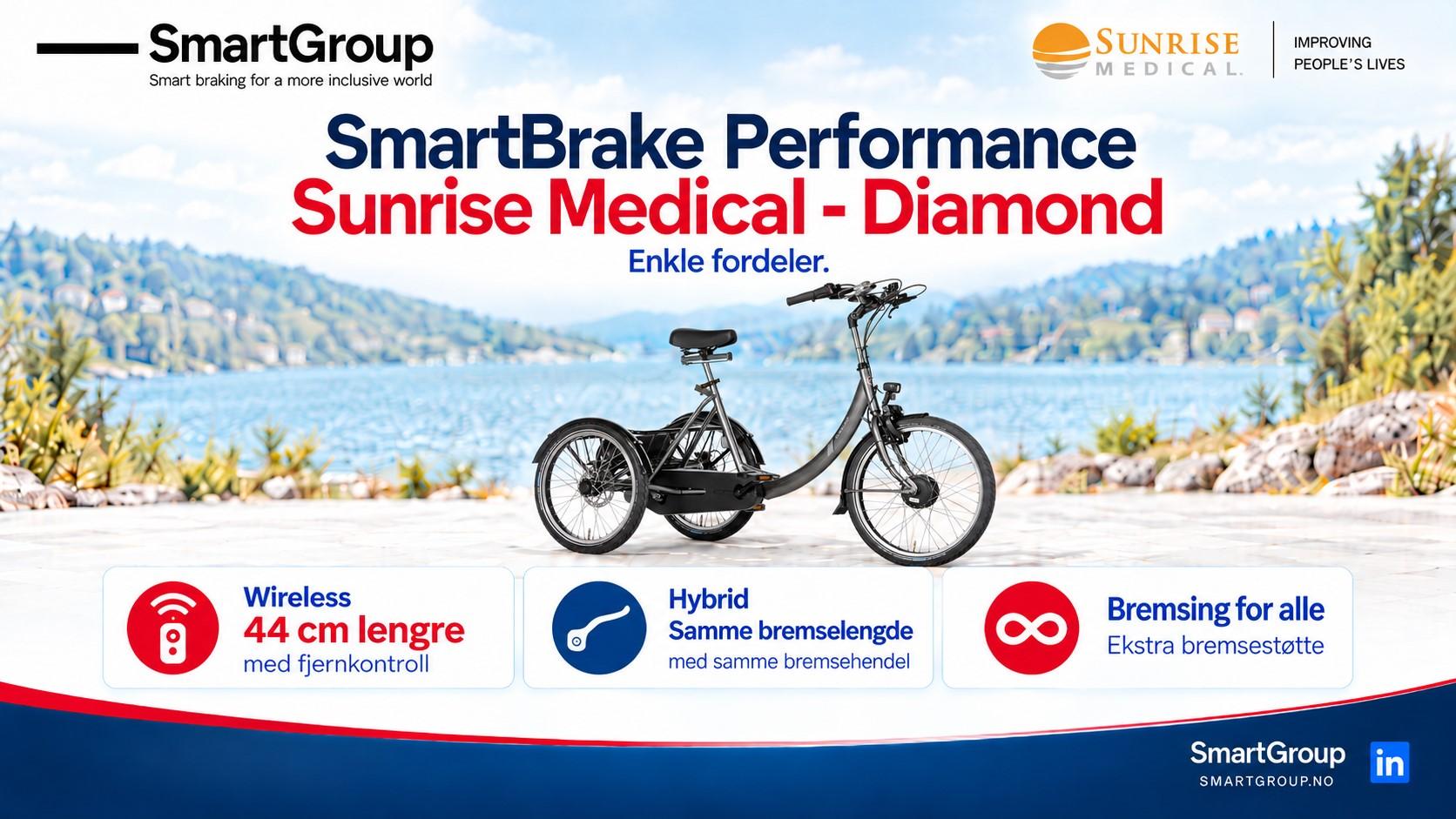
Over the summer, we carried out a series of braking tests with SmartBrake Hybrid on an adapted adult tricycle. The aim was to see how SmartBrake works in practice and compare it with the cycle's original braking system.
Activation and measurements in the test
SmartBrake is designed, among other things, for people who may find it difficult to brake quickly and firmly enough using a conventional brake lever. If the cyclist cannot squeeze the lever with sufficient force or speed, the full capacity of the original brake will not be used either.
SmartBrake allows the brake to be activated using a controller. Actual stopping distance depends on factors including configuration, speed, surface and operation.
The testing also showed that SmartBrake provides strong braking force and comes close to the cycle's original braking system in total measured stopping distance.
In the test described, average stopping distance was measured at 4.6 metres with the original brake and 5.1 metres with SmartBrake. These figures apply to the configuration and conditions of this test; they do not establish stopping distances for other cyclists or situations.
For the target group, however, it is even more important that SmartBrake makes this braking force available without the result depending on how hard or quickly the cyclist can squeeze a brake lever.
The Hybrid lever offers further options
SmartBrake Hybrid can be combined with GripAdapt, which changes the position of the brake lever. Compatibility must be established for the particular configuration.
The Hybrid lever is hydraulically connected directly to the brakes and works regardless of whether the SmartBrake system is switched on or has power. Conventional hydraulic braking is therefore unaffected by the SmartBrake system.
In the test discussed, the average stopping distance for Hybrid with direct hydraulic activation was measured at 4.6 metres. This result relates to the specific test configuration.
The Hybrid lever is well suited to people who can use a brake lever and want the quickest possible direct braking, but also need assistance in other ways. For example, a companion may need to be able to brake, or the cyclist may need support because of motor or cognitive difficulties. The cyclist can then use the hydraulic lever as usual, while SmartBrake provides an additional option for assistance when needed.
More ways to activate the brake
The most important result of the summer's testing therefore concerns more than the number of metres from activation to a stop. The tests show that SmartBrake Hybrid preserves the cycle's original braking performance while providing new and more flexible ways to activate the brakes.
Hybrid combines direct hydraulic operation with the option of wireless companion control. Selecting a configuration requires assessment of the cycle, compatibility and operation.
For us, this is at the heart of SmartBrake: making cycling possible for more people.